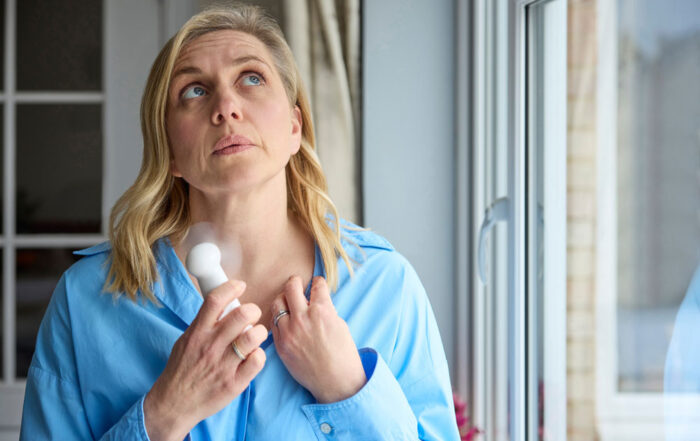
Heart palpitations are commonly reported during perimenopause, but a racing, fluttering, or irregular heartbeat should not automatically be dismissed as anxiety or hormones. Women in Nashville experiencing new or changing palpitations should understand what perimenopause may explain, what symptoms demand medical evaluation, and when urgent care may be needed.
By Leigh Anne Hulva, BSN, RN— Women’s Health Educator
[A note before we begin: What follows reflects my perspective as a nurse educator and women’s health advocate. This information draws on research on the menopause transition and the personal experiences of women navigating it. These are complex issues that present differently in every person. For that reason, this is not a clinical prescription. Please take what resonates with you, leave what doesn’t, and bring any specific concerns you have to your provider. This is simply one informed voice, offered with the hope that some part of it may be of help to you.]
Your heart races. Not during a run, not during an argument; just suddenly, for no apparent reason, while you’re sitting at your desk or lying in bed at 2 a.m. You mention it to your doctor. He glances at your chart, remarks on your age, and asks if things have been stressful lately. Arguments with the teenage kids? Frustration with the husband? You go home with a pamphlet on managing anxiety and a sense that, yet again, gender and middle age have marked you as dismissible.
Meet Marisol*
Marisol is 44, and until last year, she’d never given her heart a second thought. It had always just, you know, done its job, there in the background, quietly, the way it ought to do.
Then one day, it announced itself. She was sitting at her desk at work, mid-spreadsheet, and out of nowhere a hard, fast fluttering made her set down her coffee mug and put her hand over her chest. It was over before she even had time to get worried. But the next time it happened, it woke her from sleep in the wee hours, a heart pulsating so fast she watched the clock on her phone to count the beats. It happened a handful of times over the next few months— never dramatic enough to call an ambulance, but unsettling enough to mention at her next doctor’s appointment.
That’s when the doctor looked at her chart, commenting, “Forty-four, no cardiac history. This sounds like anxiety. Is anything stressful going on at home?” Marisol mentioned adolescent children and an underemployed husband, shrugging a bit, feeling like those kinds of everyday stressors fell under the “within normal range” category for most of her female friends. The doctor nodded knowingly—almost condescendingly, if Marisol was being honest—and handed her a pamphlet on stress management. He didn’t order an EKG. He didn’t ask any more questions.
She was back in the Nashville concierge physician’s office a few months later for something else— fatigue, mostly, and brain fog— and she mentioned that she still had racing heart episodes from time to time. “Probably perimenopause,” the doctor said this time. He had a different pamphlet for that one.
The moment that actually changed things for Marisol happened one evening while she was watching TV with her husband. Her heart did its now-familiar flutter, and she sighed, “There it goes again,” as she timed the beats with her fingers to her wrist. Her husband watched this and said, “You know, when my dad was having weird heart fluttering, he went to the doctor for them, and they had him hooked up to an EKG within the hour.” He wasn’t trying to make a point; he was just remembering out loud. But it landed like a brick.
Marisol went back to the doctor. She asked for an EKG and got one. It showed a minor but genuine arrhythmia—not an emergency, but the kind of thing that ought to be monitored. The kind of thing that might have quietly become more serious if it had gone ignored for another few years. She’s fine now, and that’s the part worth sitting with: She’s fine not because a doctor caught the problem, but rather because she advocated for herself.
[*Case studies are fictional composites drawn from the real experiences of many women. Any resemblance to specific individuals is coincidental.]
Why Heart Palpitations in Women Can be Dismissed as Anxiety
What was going on with Marisol’s heart wasn’t a fluke. And her doctor’s response wasn’t some rare event that happened in isolation. It’s a well-documented pattern. Research published in a journal of the American Heart Association found that women under 55 who presented to hospital with heart complaints were far more likely than men to have been sent home without proper cardiac testing, despite their reported symptoms.
Cardiologists who specialize in women’s health describe this— the overlap between anxiety and cardiac symptoms— as one of medicine’s most dangerous blind spots. This isn’t because anxiety isn’t real, but rather because the presence of an anxiety diagnosis on a woman’s chart too often becomes a reason to stop looking into the problem further.
Why Perimenopause Can Cause Heart Palpitations.
Estrogen and Your Heart
Estrogen, as we’ve discussed in various articles, isn’t a hormone that’s just involved in reproduction. It plays important roles in various body systems, including cardiovascular regulation. It can influence the heart’s rhythm and the blood vessels themselves. As estrogen fluctuates unpredictably during perimenopause (rather than declining smoothly), it can genuinely affect heart rate and rhythm.
Palpitations can refer to a variety of heart sensations. These can include pounding, racing (a faster-than-normal heart rate for no apparent reason), a sense of fluttering (sometimes described as “birds’ wings”), “skipped” beats, “extra” beats, or a feeling of a heavy “thud” following a pause.
The Autonomic Nervous System and Heart Palpitations
Hot flashes and palpitations may be more connected than they might seem. Research has suggested that changes in cardiac vagal control (the nervous system activity that helps regulate heart rate) can occur during hot flashes. The same fluctuating hormones that are driving your hot flashes might be part of what’s driving your racing heart. This is why “it’s probably just perimenopause” can be true and still not be the end of the conversation. Perimenopause may explain a symptom, but that doesn’t mean the symptom itself doesn’t deserve a closer look.
Hot Flashes, Vasomotor Symptoms, and Cardiovascular Health
There is some emerging research that suggests that vasomotor symptoms (like hot flashes and night sweats) aren’t simple discomforts to be quietly endured. Some women with frequent and severe vasomotor symptoms show measurable differences in markers of vascular health. These markers include inflammation, arterial stiffness, and cholesterol.
Some researchers now refer to perimenopause as a “window of opportunity,” a chance to pay close attention to these signals and how they might affect (or signal information about) a woman’s cardiovascular health.
When Heart Palpitations Need Urgent Attention
Seek medical care immediately if palpitations occur with:
- Chest pain, pressure, tightness, or a sense of fullness
- Discomfort that spreads to arms, neck, jaw, or upper back
- Shortness of breath
- Dizziness, lightheadedness, or fainting
- Palpitations that are new, worsening, or lasting longer than usual
These symptoms should never be assumed to be “just” anxiety or perimenopause until a provider has actually ruled out a cardiac cause.
How to Advocate for Yourself About Heart Palpitations
Describe Your Heart Palpitations Precisely
A statement like, “My heart races sometimes” is too easy for some doctors to wave off. Something like, “My heart rate jumped to 120 while I was sitting still twice last month; once it even woke me from sleep” is much harder to dismiss with a pamphlet. Try to track any palpitations (including fluttering, skipped or extra beats, or a racing heart) in a journal. Include what you were doing when it happened, how long it lasted, what it felt like, and how fast your heart was going (or whether it was beating erratically).
Ask About Testing, Not Just the Reassurance
You can state plainly that you would like an EKG or another form of monitoring. Wanting a symptom investigated thoroughly isn’t the same as insisting that it’s serious.
If You’re Dismissed, Go Back or Get Another Opinion
Marisol’s story took three visits. That shouldn’t be the norm, but if it happens to you, know that you’re not alone and that you deserve better. Going back and asking for more investigation into any symptom that is disrupting your life is not you being difficult; it’s you advocating for yourself in a system that doesn’t always do that for you.
Conclusion
Marisol still thinks sometimes about how easily she almost just let it go. How reasonable it might have seemed to accept the doctor’s “reassurance” that her heart racing was “probably anxiety” or “probably perimenopause.” Both were true, but even together, they weren’t the full picture. She advocated for herself until she got to the bottom of the problem.
If your heart has been doing something it never used to do, that’s worth a real look. Not because something is necessarily wrong, but because you deserve to know either way, from someone who actually checks rather than someone who just guesses.
Frequently Asked Questions (FAQs): Heart Palpitations in Perimenopause
Are heart palpitations normal during perimenopause?
Heart palpitations are a commonly reported symptom during perimenopause. This is likely due to a link between fluctuating estrogen levels and their effects on the heart’s rhythm (via the nervous system). But “common” doesn’t necessarily translate to “harmless,” and that’s what you and your provider need to get to the bottom of.
How do I know if my palpitations are anxiety or something else?
This distinction does require clinical evaluation, not self-diagnosis. And remember, having anxiety doesn’t rule out a cardiac cause existing at the same time. An EKG—and sometimes longer-term heart rhythm monitoring—is how this gets properly sorted out rather than guessed at.
Can hot flashes and heart palpitations be connected?
The short answer is yes. Both can be linked to the estrogen fluctuations (and the nervous system changes) that happen during perimenopause. There is some research that suggests that— when it comes to severe vasomotor symptoms like hot flashes— some women can experience an altered heart rhythm at the same time as the vasomotor symptom. Keep track of your symptoms, noting any overlap like palpitations during a night sweat, and take them to your medical provider.
Author Bio
I’m Leigh Anne Hulva, BSN, RN— a registered nurse, women’s health educator, mother of teenaged daughters, and passionate advocate for women navigating perimenopause and menopause. I recently completed the Harvard Medical School course on Women’s Health and in these pages I relish sharing what I learned there alongside what I know from lived experience. I bring to this work not only my training, but also the personal experience of navigating the very transition I write about. It is my privilege to share both, because this work is personal to me. I hope it feels that way to you, too.
I have been on the other side of this conversation, and I understand how much it matters to feel truly heard. At Nashville Concierge Medicines, my work is supervised by Dr. William Conway, MD, and I work directly under his licensure as a nurse educator.
You can find me on LinkedIn at https://www.linkedin.com/in/leigh-anne-hulva-a37bb9290/.