How Your Brain Judges Fast; Clothing, Stress and Recovery
Care Becoming Quiet Understanding
I am William Conway, MD a Tennessee physician who practices private medicine in Nashville.
I will be your doctor.
With time, stability forms. From stability, freedom follows.
My work is to help you remain with what is difficult until it becomes understandable.
It is a privilege to witness life becoming more its own.
Summary of Prior Blog
In the previous essay, we examined how space and environment quietly shape health over time—often before conscious awareness in Nashville. We saw that homes and workplaces are not neutral backdrops, but active participants in regulating the nervous system, influencing energy, attention, and resilience day after day. In this essay, we move one step further inward. Just as space must be designed to support health, so must the structures of daily lifetime, routine, expectations, and self-understanding. Long-term health and recovery do not emerge from moments of intensity or insight, but from conditions that allow the nervous system, identity, and judgment to settle and mature over time.
The Brain Can Learn During Aging if Actively Used
With aging, the human brain appears to take one of three common clinical pathways
- No change in cognitive ability over time
- Gradual reduction in cognitive ability called “Mild Cognitive Impairment”
- Progressive and significant loss of memory and cognition which is a disease called dementia.
No change over time in cognitive ability is a key to healthy aging. Since the latter half of 20th century, scientists have found that new brain cells are born throughout life. This is a very exciting finding. What is also commonly accepted is that thinking can actually improve with age. This is summarized as “ Old dogs, New tricks, Use it or lose it”
Your eye is not a camera
What is truth? How is truth discovered? Philosophers have struggled with explanations over the centuries. A simpler question is “Is what I see real? Is what I see the truth?”
Modern neuroscience has proven that the eye in not a camera. The anatomy is clear. A camera spreads pixels evenly across an image which is recorded. In contrast, the retina, the light sensing organ has 126 million photoreceptors. But the optic nerve has only one million fibers. Our eyes cannot transmit a full photograph to the brain. The retina must edit and code what we see.
Your vision creates the World you see in Nashville
What you see is, in fact, not reality, but an image of reality created by your brain. Hence, you need to interpret what you see to obtain a closer version of reality. This employment of conscious thinking is to understand what you are seeing in not what happens normally. Normally, visual images are interpreted by the unconscious brain to provide you with a fleeting evaluation, usually forgotten immediately.
The unconscious brain is lazy. It uses shortcuts preferring simplicity and collapsing detail quickly into a gestalt.
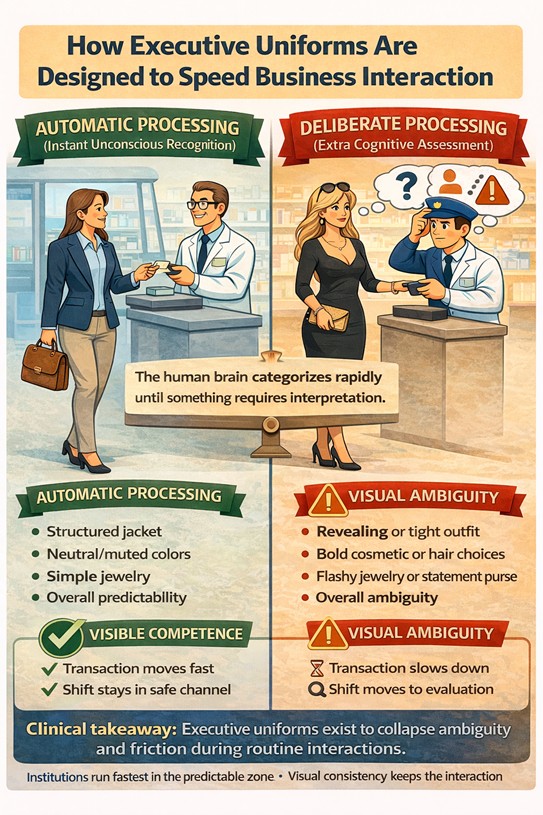
Our daily social interactions have their foundation in the rapid interpretation of the visual by the unconscious. People judge each other immediately by dress. Are you dressing in a fashion which is familiar and easily understandable by your unconscious, Or are you dressing in a more flamboyant, exciting way which the unconscious must refer to your active brain.
In general, the less which is referred to the conscious brain for evaluation, the better. In most daily transactions, you want your ticket punched so you can get on the bus.
You do not want the punching of your ticket delayed while someone is consciously trying to figure out why you are dressed, who you are, are you safe, should I punch your ticket.
If you create a familiar, easily classifiable image with your dress, you will have an easier day. In Nashville, I, William Conway, MD frequently coach my patients on these concepts
Here is an infographic demonstrating how conservative traditional dress versus expressive, personalized dress affects getting your ticket punched quickly. Conventional executive dress results in frictionless, automatic processing. More expressive, delightful dress can complicate and slow getting your ticket punched.
In contrast, traditional men’s dress leads to automatic ticket punching, while expressive, relaxed men’s dress can delay getting your ticket punched.
Understanding How Uniforms Protect Dignity, Make life Less Complex by Less Stress Interactions
A uniform is a practical agreement between you and the world. It allows others to quickly, accurately, effortlessly to place you, to classify you into an understandable position in the social hierarchy. A uniform protects you in Nashville, at least in the sense of making interactions quicker.
The daily world requires you to be classified constantly, quickly, and subconsciously, before business is transacted. When you look familiar, and are easily classified, business moves quickly and effortlessly. Your presence is accepted without friction.
Moving effortlessly through the day’s business matters. Being repeatedly questioned about identity activates your fight or flight system and tires you. Uniforms leave your flight or flight nervous system at rest.
This reduction in stress is not trivial. Over time, substantial energy is conserved for the ease going through multiple daily interactions,
The British Naval Officer suit became the paradigm men’s suit. The men suit states that the person wearing it in an officer in a contemporary business or organization, makes significant decisions, and carries significant responsibility. This statement from the suit has existed for century and continues today.
Executive dress for women has historically been more complicated because the importance of femininity as well as authority. Women have evolved an executive uniform which is distinctive, with close variations such as
- Pants suits from MM LaFleur or Ann Taylor as classic examples
- Maxi Black dresses from Nordstrom, as an example.
- The colors of women executive dress are conservative black, brown, or navy.
- The uniform is consistent, worn formally, with slight variation.
These uniforms for executives, both men and women, are easily and normally recognized. The executive has more freedom to focus upon work when dress is automatic in a uniform.
Design Rules are a reflection of Brain Rules
The brain has inborn patterns for processing visual image. If you understand brain rules, then following gestalt principles yields greater clarity and outcomes These brain rules are taught in art schools as design principles
There is a neuroscience which can inform design
Design can be applied to neuroscience.
You are not designing for.
- Intelligence
- Rationality
- Careful reading
You are designing for:
- Prediction
- Emotion
- Habit
- Speed
- Limited attention
I , William Conway, MD study neuroscience which informs design.
Conclusion
Design succeeds when it matches how the brain already works and fails when it asks the brain to behave differently.
My work is to walk with you through those decisions — quietly, steadily, and without judgment. If you are looking for a concierge physician in Nashville, please contact my office for a consultation.
📞 Call 615-708-0390
or Request a Visit to Our Website